
State roads, funding delays complicate traffic fixes
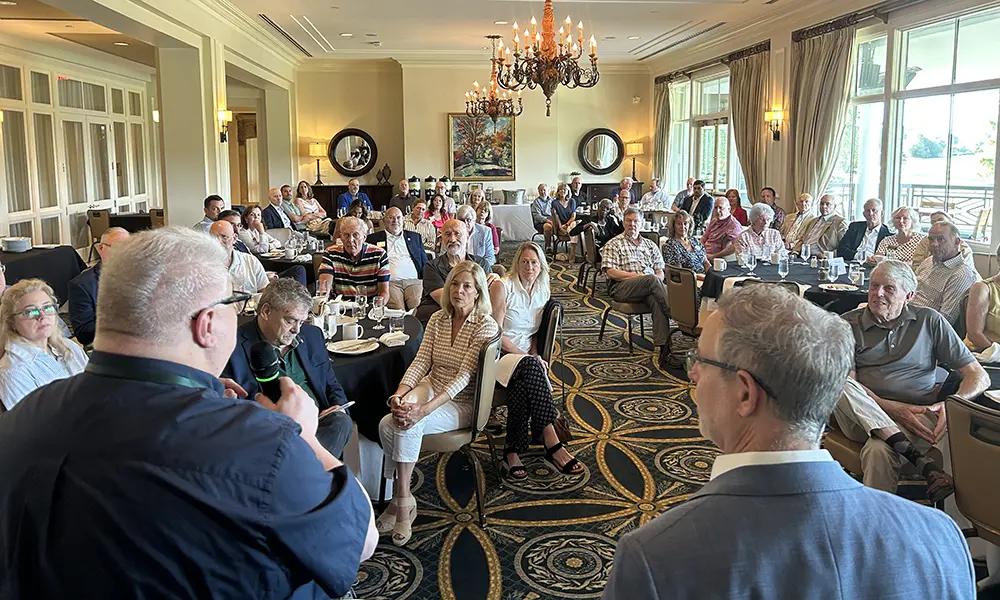
The Cornelius Today Newsmakers Breakfast was titled “Roads & Traffic” featured Wayne Herron (left) and Michael Osborne (right)
By Mark Washburn — Construction of road projects aimed at easing traffic in Cornelius is underway, but delays in the start of those and other projects largely stem from the North Carolina Department of Transportation’s inability to fund every approved project at once.
Another challenge: Nearly all of the most congested routes in Cornelius are state roads, meaning the town cannot undertake improvements to those roads or traffic signals without state involvement.
Two Cornelius leaders outlined the challenges during a recent Cornelius Today Newsmakers Breakfast titled “Roads & Traffic,” hosted at The Peninsula Club in July.

Osborne
“When the state DOT is doing the construction, we’re on their schedule,” said Michael Osborne, mayor pro tem and the town’s representative on the Charlotte Regional Transportation Planning Organization.
Ten to 15 years often elapses between a project’s planning and completion, said Wayne Herron, deputy town manager and liaison between the town and NCDOT.
The town consistently pushes for faster timelines, but the state’s definition of “near-term” often differs greatly from the public’s expectations.
“Our town board wants something done now,” Herron said. “And DOT is like, ‘Oh, that’s coming in 2031, which to them is just around the corner.'”
Road projects are expensive, and the state’s transportation budget is limited and doesn’t cover the full list of approved projects, Herron said.

Herron
One way to accelerate projects is to add local funding to NCDOT projects. Cornelius plans to spend about $45 million to help advance $450 million worth of projects approved by NCDOT.
Nearly $5 million has been secured to study a potential Exit 27 off Interstate 77 at Westmoreland Road. The new exit is not currently on the state’s project list because of its estimated $100 million cost, but Osborne said he believes the project could advance because right-of-way acquisition costs are expected to be lower than originally estimated.
Diverging diamond
The diverging diamond interchange over Interstate 77 has delivered on its safety goals, Herron said, resulting in a 67% reduction in crashes at the Catawba Avenue/I-77 interchange, with injury crashes falling 91%. He said the bridge carries about 78,000 vehicles on a typical weekday.
Even so, the interchange remains a frustration for tens of thousands of motorists. The design has been implemented elsewhere since it was introduced in 2014, but Cornelius’ interchange remains the smallest in the nation, constrained by the state’s decision not to widen the bridge over Interstate 77.
The diverging diamond and associated roundabouts were initially approved as a single project, Herron said, but the state split construction into multiple phases, extending the timeline for traffic improvements.
Osborne said he expects traffic flow to improve once the roundabouts are operational. Traffic signals along West Catawba Avenue also will be adjusted following the state’s scheduled retiming this fall, which should further improve traffic flow, he said.
West Catawba Avenue
The widening of West Catawba Avenue has been delayed for years because of state funding issues and longer-than-expected right-of-way acquisition, Osborne said.
Construction was originally scheduled to begin in 2018 and is now scheduled to begin in 2028, according to NCDOT’s website.
Bailey Road
Bailey Road on the east side of Cornelius poses another challenge because sections are owned by either the town or the state.
Traffic routinely backs up along the road during student pickup and dropoff at Hough High School and Bailey Middle School. School buses also delay traffic because they must stop at the railroad crossing.
Osborne said the town is working with Charlotte-Mecklenburg Schools on possible solutions, but any solution must be coordinated with NCDOT, CMS and the town. Conflicting state and school district regulations governing traffic queues have complicated those efforts.
The Charlotte Regional Transportation Planning Organization board approved $64,000 for a study beginning this summer to improve traffic flow at the N.C. 115 intersection.
2 Comments
Comments are closed.
Our Partners







Why does it cost “nearly $5 million to “study a potential Exit 27..?”
I will go to my grave saying it: the diverging diamond is idiotic