
Meet the Man Behind LKN’s Lost and Found
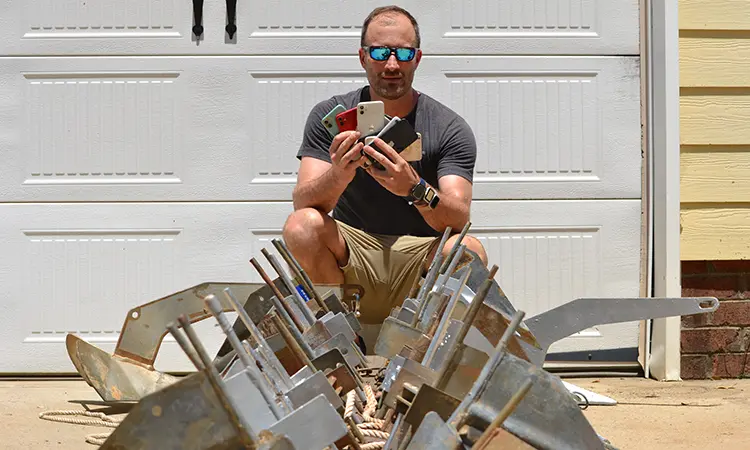
Phil Stahala with over two dozen anchors and a handful of phones found at the bottom of Lake Norman / Photo by Jason Benavides
By Jon Show – In an online video, Phil Stahala extends his hand in front of an underwater camera, opens it and reveals what he was hired to recover — one of the many valuable items he has pulled from the deep, murky waters of Lake Norman.
Is it one of the thousands of pairs of sunglasses he has found? One of the wedding rings he was hired to retrieve? Perhaps one of the hundreds of pricey anchors he has found attached to submerged trees — stuck to trunks left behind when the lake was created in the 1960s?
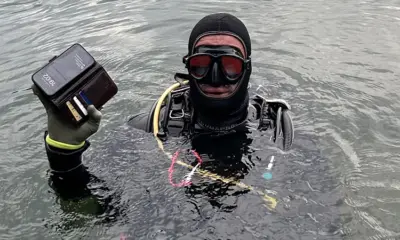
Stahala returns items with a clear owner like wallets with ID
/ Contributed photo
None of the above.
It is a prosthetic eyeball he found nestled among hundreds of freshwater mussel shells discarded by a hungry muskrat. Stahala was hired to retrieve it last summer, the morning after Fourth of July festivities, by a man hoping to avoid the $700 cost of a new replacement eye.
“I thought it was a lost cause because the inside of those shells are white, but I looked around and there it was, looking right back at me,” he said.
Open water
Ten years ago, Stahala, an avid scuba diver, started a Facebook page — Lake Norman Scuba Diver and Recovery Services — to share images and videos from beneath the surface of Lake Norman. People soon began messaging him to recover lost items.
“Word of mouth grew it from there,” he said.
The prosthetic eye video is one of 250 pieces of content he has posted over the years. He recently added a pair of dentures to his list of recovered items.
He has been paid to recover countless cellphones, including one for a woman who needed her ID and credit card in the attached wallet just hours before boarding a flight. Not only did he find the phone, but it still worked — as they often do.
“I am impressed how they survive a dip in the lake,” he said.
Other common finds include Apple Watches, thousands of sunglasses, Yeti cups, boat props, and skinny Yeti koozies — almost always with unopened cans of White Claws.
He has also fished out multiple bottles of Fireball, a flat-screen television and several drones.
The number of anchors he has found is too large to track. His record for a single day is 12, all stuck on a giant tree stump near a popular spot he declined to identify.
“I thought I could find the stump again, but I haven’t been able to locate it,” he said. “I’m sure it’s loaded up with anchors again.”
Diver for Hire
Rings are the most difficult items to find — they take unpredictable paths once they sink. He said he has only been hired to search for men’s wedding bands, never a woman’s engagement or wedding ring.
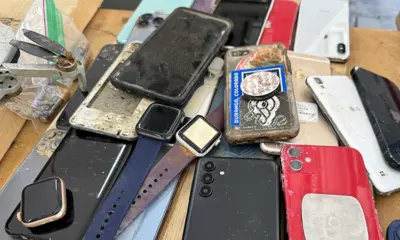
One of the many valuable items pulled from the deep, murky waters of Lake Norman was a prosthetic eyeball (not shown)
Searches are easier when there is a fixed point to establish a grid. In open water, where a woman once lost a $50,000 bracelet on a Jet Ski, recovery is impossible.
Even in shallower depths, murky water and limited light compound the challenge, and sometimes his flashlight isn’t much help.
“Visibility is always the biggest problem, and so is the silt bottom where items can disappear,” he said. “Usually I can see the outline of a phone, but sometimes I have to feel around for it.”
His fee varies based on travel distance and the difficulty of the retrieval. He returns items he is hired to find, or those with a clear owner — like wallets with IDs — while others remain in storage at his home.
One returned item was an Apple Watch whose owner showed up on Stahala’s front porch a week after the recovery when, unbeknownst to him, the device’s tracking feature reactivated.
“It kind of caught me off guard,” he said.
The lake is 33,000 acres, so if you lost something, it is unlikely Stahala found it. Even if he did, there needs to be some form of proof of ownership.
“Someone messaged me and asked if I found their Goodr sunglasses,” he said. “I have so many that who knows?”
Under the surface
Beyond his diving gear, Stahala carries only a GoPro camera, the flashlight, a knife and an occasional metal detector. The detector has turned up plenty of nails. He has encountered fish, turtles and snakes, but nothing threatening.
“Luckily nothing dangerous has happened,” he said. “I do carry a knife in case I need to cut myself out of a situation.”
He said his most unexpected discovery came in about 15 feet of water near the sandbar party area — remnants of an old road that once extended from what is now Bethel Church Road toward Denver.
Stories persist of barns, homes and other structures left standing during the two years it took to flood the Catawba River basin, but Stahala has never seen any of them.
“I have never found any, but I also don’t go that deep looking for them,” he said.
Stahala works full time as a computer drafter for an engineering firm, making scuba diving a hobby — one he does not envision abandoning anytime soon.
“I don’t see people not losing items in the water,” he said. “As long as they keep dropping things, I’m willing to come find them.”
Our Partners