Sailing Center Sets New Course
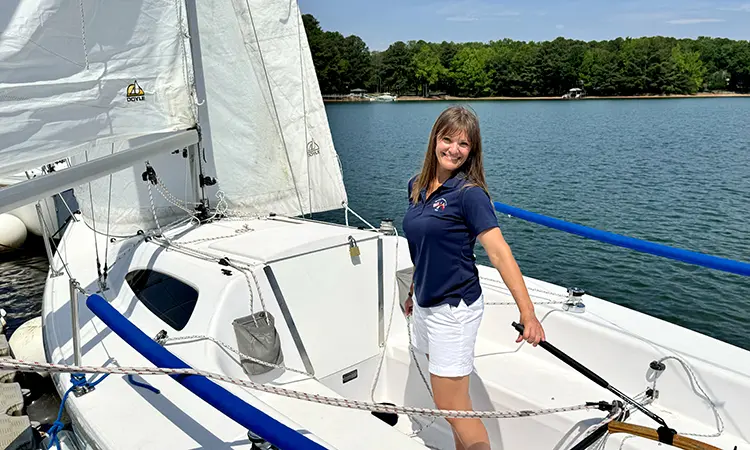
Kasia Fthenos, head of Lake Norman Community Sailing / Jason Benavides photos
By Jon Show – Sitting on a leather sofa on the shores of Lake Norman, in the Larry Vitez Sailing Center, Kasia Fthenos is asked about her most memorable journey over nearly four decades of sailing.
She smiles. The answer comes without hesitation.
At 17, she crewed a voyage on the Merkury, a steel-hulled yawl rig that set out from Poland bound for Amsterdam, then pushed through the English Channel and traced the eastern coastline of England. From there, the route turned north around Scotland and into the Shetland Islands.
 “It is one of the most dangerous places to sail across—it’s basically the Cape Horn of the Northern Hemisphere,” she said, describing the Pentland Firth, where currents can run at 15 knots and the sea compresses into unpredictable motion between rocks and whirlpools.
The experience began to shape not only her seamanship but her sense of how to move through changing conditions as wind, water, people and uncertainty all shift at once.
Years later, she finds herself applying that same mindset far from the North Sea, on a much quieter stretch of water on Lake Norman.
Welcome to the lake
As the new head of Lake Norman Community Sailing, Fthenos is now navigating a different kind of course: growing a nonprofit sailing center on the lake and working to bring renewed energy to the sport she loves.
“There is so much energy—amazing energy from the volunteers and the community,” she said. “We have some challenges, but people support sailing all across the lake, and it is electrifying.”
The center operates on a mission that sounds simple but proves complicated in practice: make sailing accessible. That means instruction for beginners, programs for children, recreational sailing for members and an effort to shift perceptions about who sailing is for—and what it looks like on a lake dominated by powerboats.
But before the organization can grow outward, it first must make itself more visible.
“We’re trying to change a lot of things, add more energy, invite the community, open up to the community, let them know about us,” she said. “A lot of people just don’t know that we’re here.”
Sailing on Lake Norman has long been fragmented—spread across yacht clubs, private docks and small pockets of organized racing. While sailing has deep roots on the lake, observers say visibility and access have never fully caught up with its potential.
Fthenos believes that can change.
Focused on growth
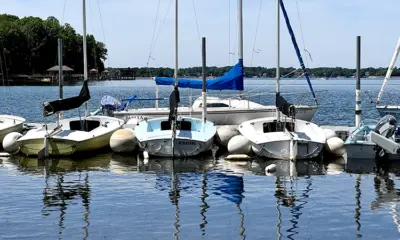
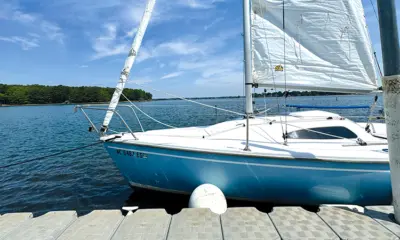
Membership at the center currently sits around 160 individuals or families who pay a few hundred dollars a year to get seven-day-a-week access to any of the 31 sailboats during daylight hours.
Think of it as the original boat club at a much more affordable price point.
Fthenos hopes to double the membership rolls in her first year, but growth is not just about numbers. It is about reshaping what the experience feels like once people arrive.
 For years, much of the structured activity focused on racing. That model worked for dedicated sailors but left many newcomers feeling excluded.
“Not everybody is into racing,” she said. “Sailing can offer so much more than that.”
To address that gap, the organization introduced a weekly “Fun Day on the Water,” a more relaxed program designed to lower the barrier to entry. Members can sail casually, practice skills under supervision, or simply spend time on the water without competition.
“It’s fun on the water, it’s a fantasy being on the water,” she said. “We’re open for cruising, learning, anything.”
That shift reflects a broader strategy: make sailing less intimidating, more social and more family-oriented.
Youth programs are central to that vision. This summer marks the return of structured sailing camps for the first time since 2019. The camps for children ages 7 to 17 will use Sunfish sailboats, small craft that allow beginners to quickly learn basic handling while still feeling the wind and water in full force.
High school sailors are expected to play an important role as volunteers and mentors.
“The young volunteers are amazing because they are full of energy,” she said. “If they have fun, they will tell everybody. They will bring the family over here. They will bring more friends.”
That ripple effect, she believes, is key to rebuilding a sailing culture that is a centerpiece of the lake and not something peripheral.
Bigger picture
There is also a longer-term vision taking shape—one that extends far beyond Lake Norman.
She has begun reaching out to other community sailing organizations along the East Coast, including groups in Boston, Miami and Key West, with the idea of building a connected network where sailors can move between programs, travel for events and learn from different sailing environments.
“How awesome would that be to have some kind of connection among different sailing communities across the United States?” she said.
The idea includes both cruising and racing opportunities, as well as what she described as “field trips” for adults and families—an attempt to break the idea that structured adventure belongs only to youth programs.
“Adults want to do that too,” she said. “Especially people with empty nests, still full of energy.”
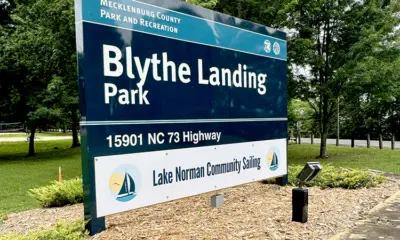 Even with those changes, Fthenos is clear that growth will not happen overnight. Infrastructure limitations remain, including dock space and permitting challenges tied to shoreline management. But she sees those obstacles as part of the process rather than barriers to it.
In five years, she imagines a very different scene on the waterfront: more boats, more classes, a larger staff and a steady flow of families moving between docks, classrooms and open water.
“Loaded with kids and families of different ages,” she said. “That would be full success.”
Eye toward the future
Beyond numbers or facilities, Fthenos returns to something simpler: atmosphere. That energetic feeling and the potential of a resurgence in her life’s passion is what fuels her, and she believes the foundation is already laid.
“The amount of energy here is electrifying,” she said. “It will grow on Lake Norman. There will be more sailors.”
It is the same sense of forward motion she once felt offshore in rough northern waters—only now, instead of navigating whirlpools and shifting currents at sea, she is navigating something closer to home: how to help a community find its way back to the helm.
“I really believe that we can do it,” she said. “We’re going to grow and bring more people in. That spark that is here now? It will grow.”
Our Partners