Lake Levels Rebounding Anytime Soon?
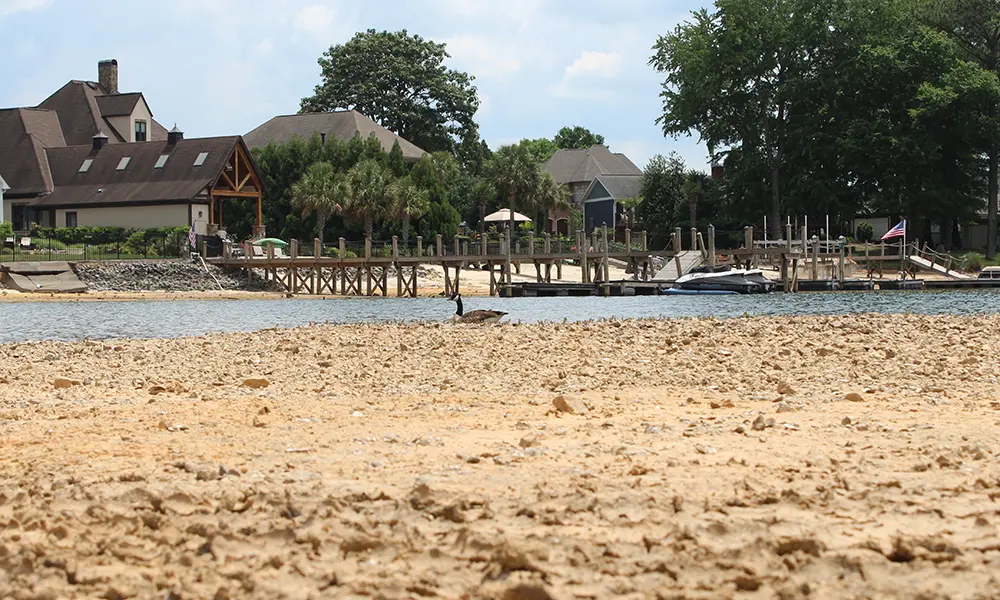
Lake Norman has hovered around 95 feet this summer, roughly 3.5 feet below its seasonal target level
By Jon Show—Water levels on Lake Norman might look better this week, but a return to normal and the easing of drought restrictions will be lengthy process, according to Duke Energy engineers.
“It took a long time to get into this level of drought, and it will take a long time to get out of it,” said Brett Hartis, a water resources manager for Duke Energy.
Until this week, Lake Norman has hovered around 95 feet most of this summer, roughly 3.5 feet below its seasonal target level. Water levels improved slightly after the area received 5 inches of rain in late May, but June brought only 2 inches of rain, followed by another 5 inches in July and 2 inches so far in August. Much of that precipitation came from fast-moving, localized storms rather than widespread rain events.

Hartis
The Catawba River watershed has been trending toward drought since October 2024, following Hurricane Helene. Since then, roughly 70% of the months have received less than half their normal rainfall.
The extended dry period has left groundwater severely depleted, meaning much of the recent rainfall has soaked into the ground instead of flowing into streams and reservoirs. That explains why lake levels have risen throughout the summer after rain, only to return to lower levels in a few days without additional precipitation.
“The groundwater is bone dry, and we need a complete shift in the weather pattern and sustained periods of long rain,” said Hartis. “Right now, any of these rain events are like pouring water over a dry sponge.”
Water restrictions
The Charlotte region remains under Stage 2 of Duke Energy’s Low Inflow Protocol, or LIP, which requires Duke Energy to reduce hydroelectric generation. When hydroelectric generation is reduced, the utility relies more heavily on other energy resources to help meet customer demand.
That shift does not immediately impact lake levels, a Duke Energy spokesperson said.
Duke Energy also has suspended recreational water releases downstream — flows used for activities such as rafting and kayaking — to conserve water and avoid more restrictive drought measures.
The LIP, developed after the historic 2007-08 drought, outlines a series of water conservation measures based on reservoir storage, drought conditions and stream flows.
Duke Energy manages all 11 reservoirs in the Catawba-Wateree River Basin, stretching nearly 225 miles from Lake James near Marion to Lake Wateree near Columbia, South Carolina.
Lake Norman and Lake James are the two largest reservoirs in the system and play a critical role in maintaining downstream water levels, including at Mountain Island Lake, the primary drinking water source for Charlotte and several surrounding communities, including Cornelius.
“We have to maintain environmental flows downstream of all of these reservoirs, so there is always water moving between reservoirs,” Hartis said.
Evaluating conditions
Three primary factors determine the drought stage: reservoir storage, the three-month average of the U.S. Drought Monitor and stream flows measured over a six-month average. While recent rainfall has helped reservoir levels and drought conditions improve slightly, stream flows remain well below normal, making it unlikely the region will move out of Stage 2 anytime soon.
“We’re entering the hotter and drier months, so this is not the time to pull back and relax because we can quickly move through all the gallons of water we’ve saved this summer,” Hartis said.
He estimated the watershed’s water storage deficit at billions of gallons.
“It’s a marathon,” Hartis said. “We didn’t get into this situation because of a couple days of dry weather. It’s going to take months of sustained, steady rainfall.”
The most recent prolonged drought occurred from 2007 to 2009. During that period, restrictions advanced to Stage 3, where they remained for about a year before conditions improved following a wetter-than-normal summer and a series of tropical rain events during the active 2008 hurricane season.
Forecasters are predicting a below-normal Atlantic hurricane season this year, reducing the likelihood of the type of widespread tropical rainfall that helped ease the last major drought.
“Every little bit counts, but it’s a long-term recovery that’s going to take a substantial amount of time,” Hartis said.